Insights • Guide
Insights • Guides
Ramadan 2026 NYC Guide: Iftar, Taraweeh, Timings, Events & Tips
Your essential NYC Ramadan 2026 guide—iftar spots, taraweeh, key dates, events, transport tips, and healthy fasting insights for the month ahead.
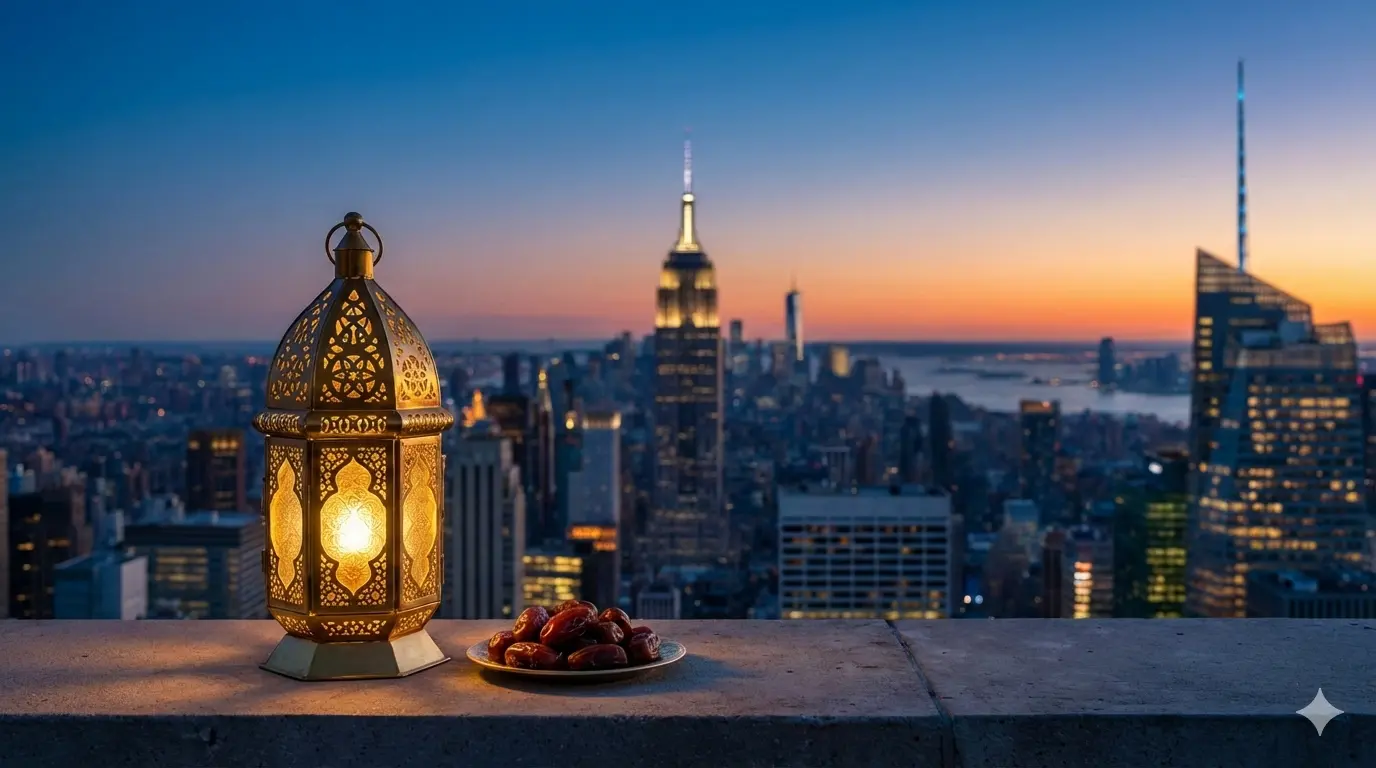
Ramadan 1447 AH is expected to begin in New York City on Wednesday, February 18, 2026, following the announcement by the Fiqh Council of North America (FCNA), which confirms that the astronomical new moon will be born before sunset on Tuesday, February 17, making the next day the first day of fasting. Tarāwīḥ prayers therefore begin on Tuesday night, February 17.
The month is anticipated to conclude with ʿEid al‑Fitr on Friday, March 20, 2026, based on FCNA’s adopted visibility criteria.
While these dates offer a reliable planning framework, they remain subject to local confirmation, as many NYC masājid rely on local or regional moonsighting to determine the official start of Ramadan. Differences between calculation and physical sighting—especially in borderline visibility cases—mean that start dates may vary slightly across communities. Always follow the announcement of your local masjid or Islamic center for the final, authoritative ruling.
Follow your local masjid
Always check your local timetable daily—methods differ (calculation vs. local moonsighting), so rely on your imam/board announcements.
Start & key dates (expected)
The Fiqh Council of North America (FCNA) has announced that for Ramadan 1447 AH, the astronomical new moon is born before sunset on Tuesday, February 17, 2026, making Wednesday, February 18, 2026 the first day of fasting in North America; tarāwīḥ begins Tuesday night (Feb 17). FCNA further indicates that Shawwāl 1 (ʿEid al‑Fitr) will be Friday, March 20, 2026, based on its calculation thresholds (elongation ≥ 8° and lunar altitude ≥ 5° at sunset somewhere on the globe).
On day 1 in NYC, plan for Maghrib/iftar around 5:35 PM, with times increasing through the month; reputable NYC tables (e.g., Sajda and IslamicFinder) list Maghrib near 5:35–5:36 PM on Feb 18 and then climbing steadily, with a Daylight Saving Time shift on March 8. Always follow your local masjid’s timetable, as some communities confirm start dates by local moonsighting rather than calculation.
Daily rhythm at a glance
Suhoor → Fajr: Finish pre‑dawn meal a few minutes before Fajr; set a warning alarm. (NYC tables provide precise Fajr/Imsak times you can save to your phone.)
Fasting window: From dawn to sunset (Maghrib).
Iftar: Break with dates and water at Maghrib; pray Maghrib before a bigger meal; times lengthen nightly on NYC calendars.
Evening prayers: ʿIshāʾ + tarāwīḥ after nightfall; durations vary by masjid and whether they complete a juz’ nightly.
Where to break fast (borough‑by‑borough)
Manhattan. Campus MSAs and downtown masjids often host recurring iftars; in recent years, Muslims have held public tarāwīḥ in Times Square, drawing crowds and media attention—arrive early, bring a mat, and dress for wind. [ny1.com], [invisiverse.com]
Queens. Jackson Heights and nearby corridors are ideal for late‑night halal eats—South Asian bakeries, Afghan and Bangladeshi spots—useful for post‑tarāwīḥ snacks or suhoor; confirm each masjid’s nightly schedule via bulletin or WhatsApp.
Brooklyn. Bay Ridge clusters dessert and tea shops for a gentle wind‑down after prayers; community centers frequently run food drives—consider adding a canned‑goods drop to your route.
Bronx & Staten Island. Expect smaller congregations with strong neighborly vibes; monitor local pages for pop‑up iftars and youth programs.
Across the River. Jersey City and Newark often feature sidewalk iftars and family‑friendly tarāwīḥ; double‑check mosque notices and city permits week‑to‑week.
Public‑iftar essentials (checklist): a compact prayer mat; layers (wind‑breaker + hoodie); water + 2–3 dates; small waste bag; portable charger; and a plan for elders/ADA access.
Public iftar essentials
- Compact prayer mat
- Layers (wind‑breaker + hoodie)
- Water + 2–3 dates
- Small waste bag\n- Portable charger
- ADA/elder accommodations plan
Notable events & what to expect
Times Square tarāwīḥ. Media reported public tarāwīḥ in 2024 and 2025 with Qurʾān handouts, nasheeds, and significant public interest; if you go in 2026, expect crowd control, cameras, and interfaith curiosity. [ny1.com], [invisiverse.com]
City “Iftar on the Go.” NYC’s Comptroller and partners have staged multi‑borough distributions of boxed halal dinners—8,500+ meals in 2024 and 12,000+ in 2025—typically first‑come, first‑served; monitor official channels for 2026 schedules. [facebook.com], [iha.news]
Tips for public gatherings: Bring a compact mat; pack a date and water; treat sidewalks and storefronts respectfully; designate a rendezvous point for families and youth groups; and volunteer for cleanup if you can—these small courtesies help events return next year. (City press releases give a sense of scale and volunteer needs.) [facebook.com], [iha.news]
Community etiquette
Pre‑open your iftar box after the adhān, keep sidewalks clear, set rendezvous points, and volunteer for cleanup so events are welcomed back each year.
Health & hydration (practical, not prescriptive)
Think of hydration as a cadence from Maghrib to Fajr, not a single chug at iftar; aim to sip regularly and spread fluids across your evening. For electrolytes, a zero‑sugar blend can help retention; distribute sodium and potassium across your evening meals (soups, broth, dates, bananas). For suhoor, use a simple macro template: complex carbs (oats, brown rice, whole‑grain roti) + protein (eggs, yogurt, legumes) + produce + healthy fat (nuts, olive oil). Taper caffeine 3–5 days before Ramadan to blunt headaches. Keep movement light—a short walk after iftar—and schedule workouts late afternoon or post‑tarāwīḥ. If you have medical needs (kidney, cardiac, diabetes, pregnancy), consult your clinician and your imam for exemptions or adjustments; the tradition values health and accommodates genuine hardship.
Hydration is not a chug—it’s a cadence between Maghrib and Fajr.
Sample schedules
Weeknight (worker/student)
5:20 PM Arrive near your masjid/event; keep a date + water accessible.
~5:35 PM Iftar at Maghrib → light bites → pray Maghrib (NYC Maghrib increases nightly; check your table).
6:15–8:15 PM Commute + family meal or community iftar.
8:15–9:45 PM ʿIshāʾ + tarāwīḥ (duration varies).
10:00–11:00 PM Light walk and hydration cadence.
4:45–5:15 AM Suhoor + Fajr (shift earlier as days pass and be mindful of the DST jump on Mar 8).
Weekend (community night)
Stagger arrival for seating at a neighborhood bazaar or fundraiser; attend a public tarāwīḥ or a masjid khatm night; and plan transport for elders and kids with a firm curfew or driver rotation.
Transport & late‑night logistics
Ramadan often runs late; mobility planning makes it more inclusive. For larger masjids or events, consider group shuttles on busy nights (youth, seniors, reverts). Mark pick‑up zones near entrances (well‑lit, consistent) and train volunteers as traffic marshals. If you host a bazaar or nightly iftar, budget for ADA access and stroller parking; it reduces door congestion and creates a calmer experience. For an experiential night, try a cross‑borough itinerary: Manhattan tarāwīḥ followed by a Queens suhoor crawl—or Bay Ridge desserts after a Brooklyn khatm.
Budget & giving
Create a Ramadan budget with line‑items for staples (dates, grains, legumes), suhoor proteins, rideshares, charity (zakāt and sadaqah), and Eid outfits/gifts. Prioritize local giving—food banks, masjid pantry programs, refugee assistance, and college student iftar funds—and volunteer hours (kitchen prep, cleanup, security, translation, childcare during tarāwīḥ). Also watch for the city’s “Iftar on the Go” distribution schedule to volunteer or guide neighbors to the nearest site. [facebook.com], [iha.news]
Why dates differ: calculation, local moonsighting, and the role of illumination
FCNA’s calculation method. FCNA recognizes astronomical calculation as a valid Sharʿī method to determine the start of lunar months and uses the ECFR visibility criteria: at sunset somewhere on earth, elongation ≥ 8° and the moon ≥ 5° above the horizon. This enables early planning for schools, work leave, venue permits, and inter‑community coordination; FCNA’s 2026 notice lays out this rationale and the expected dates.
Local moonsighting: benefits of “witness.” Many communities prefer local or regional moonsighting for its emphasis on witnessing the crescent in one’s own skies, strengthening local unity and keeping practice anchored in real atmospheric conditions. Technical discussions from UK moonsighting groups emphasize that sunset–moonset geometry is inherently local, and clouds, haze, and light pollution can thwart a sighting even when a distant region reports success. [dateandtime.info]
Illumination & visibility basics. Early crescent visibility depends on several astronomical and observational factors—moon age, elongation (Sun–Moon angular separation), altitude, sky transparency, observer experience, and latitude/season. The US Naval Observatory notes that within ~1 day of new moon the crescent is often very thin and low in bright twilight, making sightings challenging and highly variable month to month; “record‑early” naked‑eye sightings (12–15.5 hours) exist but are exceptional. For prediction methods, astronomers widely reference the Yallop algorithm, which classifies visibility bands based on a parameter q that correlates with ease of naked‑eye detection—helpful for maps and planning but still sensitive to local weather and light. [a.msn.com] [sunrise-sunset.org]
A 2026 edge‑case. FCNA flags 2026 as a borderline scenario: although the numerical thresholds are technically met on the evening of Feb 17, the age and illumination fraction are extremely small, so practical visibility may be marginal to nonexistent in many places—an example of why some communities await local confirmed sightings before starting. In NYC, the upshot is simple: choose one method with your masjid and maintain neighborly grace when others follow a different (yet valid) method.
Quick FAQ
Maghrib on day one?
Around 5:35 PM on Wed, Feb 18 in NYC (check your preferred timetable and your masjid’s method); times increase daily and jump with DST on Mar 8.
Why does my friend start on a different day?
Methodology. FCNA/ISNA use astronomical criteria to set dates in advance; local moonsighting communities wait for an actual sighting or complete 30 days of Shaʿbān if not seen—both are part of the broader juristic discourse. Follow your local imam/board for unity. [dateandtime.info]
Why does my friend start on a different day?
Will Times Square tarāwīḥ happen again?
It ran publicly in recent years; watch organizer notices and city permits. If you go, bring a mat, dress for wind, and expect large crowds and media. [ny1.com], [invisiverse.com]
For a full list of resources, see our Ramadan 2026 NYC Featured Guide.
Save & share
Bookmark a daily NYC timetable you trust (e.g., Sajda/IslamicFinder) and set recurring alerts (10 minutes before suhoor end; 5 minutes before iftar).
Share this guide with someone experiencing their first Ramadan in NYC and plug them into a nearby masjid.
Keep an eye on city distributions and bring a friend to volunteer; it’s an easy on‑ramp into community service. [facebook.com], [iha.news]
Daily prayer & Ramadan tools
- Sajda NYC Ramadan 2026: https://sajda.com/en/ramadan/united-states/new-york-new-york-city/5128581
- IslamicFinder NYC Ramadan 2026: https://www.islamicfinder.org/ramadan-calendar/5128581/new-york-city-nyc-ramadan-calendar/
- FCNA 2026 announcement: https://fiqhcouncil.org/ramadan-2026-announcement/\n- USNO Crescent Visibility FAQ: https://aa.usno.navy.mil/faq/crescent
Sources
- FCNA Ramadan–Shawwāl 1447 / 2026 announcement (criteria, dates): https://fiqhcouncil.org/ramadan-2026-announcement/
- Sajda NYC Ramadan 2026 timetable: https://sajda.com/en/ramadan/united-states/new-york-new-york-city/5128581
- IslamicFinder NYC Ramadan 2026 calendar: https://www.islamicfinder.org/ramadan-calendar/5128581/new-york-city-nyc-ramadan-calendar/
- **USNO crescent visibility (why “thin” hilāl is hard to see): **https://aa.usno.navy.mil/faq/crescent
- Times Square taraweeh coverage (2024): https://www.arabnews.com/node/2474606/world
- Times Square taraweeh coverage (2025): https://www.siasat.com/video-times-square-hosts-taraweeh-prayers-for-third-consecutive-year-3189667/
- NYC “Iftar on the Go” (2024): https://comptroller.nyc.gov/newsroom/press-releases/nyc-comptroller-islamic-relief-usa-and-community-based-orgs-to-host-iftar-on-the-go-meal-distributions-throughout-ramadan/
- NYC “Iftar on the Go” (2025): https://comptroller.nyc.gov/newsroom/press-releases/nyc-comptroller-islamic-relief-usa-and-community-based-orgs-to-host-iftar-on-the-go-meal-distributions-throughout-ramadan-2/